Liberty. Economics. Common Sense. These are the guiding posts for this blog, and we hope, for the way most of us live our lives. This blog comes to the conclusion that the proper direction for society is one of personal liberty, both economic and political, and limited government that follows sound economic policy.

This blog will offer economic analysis on many political issues of the day along with political theory from time to time. The major inspirations for this blog are writers and thinkers like John Locke, Adam Smith, David Ricardo, Alfred Marshall, F.A. Hayek, Milton Friedman and James Madison among others.

Friday, August 13, 2010

Property Rights Fall Through New York's Nets

The New Jersey Nets basketball team announced that they will change their name when they move into their new stadium. Why is this significant? Well, the fact that they’re changing their name isn’t significant at all. What is significant, and it’s a shame and an outrage that it has gone largely unnoticed or uncared by the media and public at large, is that the land the stadium is to be built on was taken through eminent domain.

The stadium is part of a larger commercial development that includes high-rise office and residential towers. The ruling granting the eminent domain is outrageous – outrageous! This is a clear violation of the 5th Amendment, which clearly states, “No person shall be…deprived of life, liberty, or property, without due process of law; nor shall private property be taken for public use, without just compensation.”

The issue thus becomes what does “public use” mean? Since the disastrous case of Kelo v. New London, the courts have come to interpret “public use” to mean “public purpose” and indeed it’s exactly this misinterpretation that the New York Court, in its foolish decision, chose to use:
“…the proposed land use improvement project will, by removing blight and creating in its place the above-described mixed-use development, serve a ‘public use, benefit or purpose’…”

They continue:
“…while the State Constitution, literally read and in its early construction, permitted the taking of property only for ‘public use,’ ‘public use’ had since come to be understood as entailing no more than a dominant public purpose.”

Grrr. No, it hasn’t! Damn you Kelo! The Founders had a very clear idea on the vision for their new country. The Constitution is only about 10 pages, but they left 400 pages of Federalist Papers and volumes of other writings to leave little doubt as to what the Constitution means. The Constitution is purposefully simple and direct. It means what it says it means. When the Founders say “public use”, they don’t mean “public purpose”. If they meant “public purpose”, they would have said “public purpose”! As James Madison says in Federalist No. 62:
“It will be of little avail to the people that the laws are made by men of their own choice, if the laws be so voluminous that they cannot be read, or so incoherent that they cannot be understood; that no man who knows what the law is today can guess what it will be tomorrow.”

Because they knew the Constitution would be basically inaccessible if it contained the detail found in the Federalist Papers, it was intentionally left simple and concrete with the understanding that people would refer back to original intent when interpreting it.

So how do we know that the original intent of the Founders was to hold private property in an almost sacred light? Well, they tell us. First, their inspiration for government becomes clear when we understand who they looked to as their mentors. The Declaration of Independence verges on plagiarism of John Locke, who wrote extensively of the importance of private property and the government’s duty to protect it.

More clearly, Madison himself clearly explains the government’s role in protecting private property in his work “Property”. He says:
“Government is instituted to protect property of every sort; as well that which lies in various rights of individuals, as that which the term particularly expresses. This being the end of government, that alone is a just government, which impartially secures to every man, whatever is his.”

And further:
“That is not a just government, nor is property secure under it, where the property which a man has in his personal safety and personal liberty, is violated by arbitrary seizures of one class of citizens for the service of the rest.”

Very clearly, the Founders did not intend that private property could be taken to achieve a “public purpose”. “Public purpose” is such a nebulous concept that virtually any reason could be considered as achieving a “public purpose”. If private property can be taken for a public purpose, then it ceases to become an inherent and unalienable right and therefore government has no duty to protect it. Once we are not secure in our property, we are not secure in our life or our liberty either. Private property is the lynchpin that holds it all together. Indeed, if our private property rights are undermined, the Constitution becomes meaningless.

As if that’s not outrageous enough, the court took an almost glib attitude in this case, as if they weren’t debating a person’s very livelihood, as if they weren’t gambling with the foundation of our entire way of life. The court states:
“…it is indisputable that the removal of urban blight is a proper, and, indeed, constitutionally sanctioned, predicate for the exercise of the power of eminent domain. It has been deemed a ‘public use’ within the meaning of the State's takings clause….and is expressly recognized by the Constitution as a ground for condemnation. Article XVIII, § 1 of the State Constitution grants the Legislature the power to ‘provide in such manner, by such means and upon such terms and conditions as it may prescribe . . . for the clearance, replanning, reconstruction and rehabilitation of substandard and insanitary areas’…"

First of all, urban blight is not an “indisputable” reason to take away a person’s property, but even if it were, if guarding against blight is necessary for the “clearance, replanning, reconstruction and rehabilitation of substandard and insanitary areas”, that would fall under the state’s police power and thus it wouldn’t be a taking.

Either 1) the property can be put to better use if it serves a “public purpose”, or 2) it is dangerous to the health, morals and safety of the community and thus under the authority of the police power. By trying to argue both fronts shows the state doesn’t really have a good reason to take the property and they are hoping nobody will notice if they build the strongest case possible by throwing the entire arsenal at it.

In what would be almost comical if it weren’t so serious, they undermine their own strategy:
“Petitioners, of course, maintain that the blocks at issue are not, in fact, blighted and that the allegedly mild dilapidation and inutility of the property cannot support a finding that it is substandard and insanitary within the meaning of article XVIII. They are doubtless correct that the conditions cited in support of the blight finding at issue do not begin to approach in severity the dire circumstances of urban slum dwelling described by the Muller court in 1936, and which prompted the adoption of article XVIII…”

So the Appellate Court basically says that they don’t consider the area blighted, and therefore not subject to condemnation, but they defer completely to the lower courts and the legislature:
“…judges may substitute their views as to the adequacy with which the public purpose of blight removal has been made out for that of the legislatively designated agencies; where, as here, "those bodies have made their finding, not corruptly or irrationally or baselessly, there is nothing for the courts to do about it, unless every act and decision of other departments of government is subject to revision by the courts’…”

It’s a sad day indeed when a court fails in its most basic duties of judicial review and instead punts on such an important issue. This ruling is a failure all the way around. And just to add insult to injury, the court recognizes it is continuing a tradition of dangerous precedent and opening the door to moral hazard but seeks to rationalize it away:
“There is no reason to suppose that serial condemnation litigation will now become the order of the day.”

Right. That’s what they said about the Kelo case and look how far we’ve fallen since.

When the New Jersey Nets have their home opener to kick off the 2011-2012 season, there will be plenty of celebration. Unfortunately, when the people dance, they will have their fellow citizens’ property rights under their feet. When our government fails to protect the basic liberties of the minority it has failed in its most basic duty. I for one will not be celebrating.

Anti-Immigration and Protectionism

The argument on immigration usually goes something like this,

“Legal immigration is good, but illegal immigration is bad.”

For now, I will ignore the logical and economic fallacies inherent in such a statement, and simply shake my head that the US is further restricting the former in an effort to battle the latter.

If legal immigration is a good thing, why would we restrict it in order to battle illegal immigration? The United States massively raised the cost of visas for Indians coming to this country. The new legislation raises the visa fee to $2,000 per application, and of course, there is no guarantee that an applicant will actually receive the visa.

Why has the U.S. put such an extreme burden on potential Indian immigrants? The answer is to fund the $600 million border security bill, also passed by Congress.

This makes no sense. While I understand the need to protect our border, illegal immigration is not only unharmful, but even beneficial. It’s unfortunate that it has been turned into a bogeyman that politicians of all stripes seek to capitalize on. So not only are we going to great pains to stop something that is beneficial to our economy, we are actually hurting ourselves to do it!

Not only are we restricting legal immigration, thus voluntarily giving away its positive economic benefits, this visa rate hike is simply a measure to protect U.S. IT firms and therefore amounts to nothing more than a tariff.

With such a tariff, we lose out on the clear benefits of Comparative Advantage plus we expose ourselves to retaliatory measures which are commonplace in response to protectionist attitudes.

Immigration restrictions and protective tariffs are both very harmful to any economy so to implement one to “save” us from the other makes no sense at all.

Thursday, August 12, 2010

How Unions Hurt Workers and the Economy

Unions are certainly a hot-topic right now as they’ve seen a resurgence in power under the Obama administration. In many circles, it’s almost sacrilege to speak out against unions. Unfortunately the economic consequences of unions are not immediately obvious. Typically, the argument in favor of unions goes something like this:

“Unions are a valuable tool in maintaining both a living wage for workers, and safe working conditions.”

This is the classic argument for unions and it may, MAY have had merit 100 years ago. Laws have since been passed to protect workers’ rights and guarantee their safety. What does a union do for workers and consumers that OSHA, overtime laws, trade associations, and a 40-hour work week don’t do?

In the past, workers’ rights often weren’t recognized and maybe organizing was the only way to have their voice heard. Those days are long gone. Workers’ rights are guaranteed and affirmed through legislation; not to mention a change in culture. Any business that tried to exploit its workers would quickly find itself without employees or in jail, or both. Unions are simply not necessary to achieve this end.

Therefore, the argument that unions promote safe working conditions is hollow. So what is their true motive? People are much closer to the truth when they talk about high wages. I talk about bootleggers and Baptists often: During prohibition, there were two groups that really wanted to see alcohol outlawed. One group was the Baptists who wanted to see prohibition passed for the “right” reasons (immoral, destructive, etc.). The other group was the bootleggers because they knew they would make a ton of money.

We can think of unions in the same light. Many people have honest, albeit misguided, ideas of unions being good for the worker. These people are the Baptists. The bootleggers are the Union organizers, and once they have a few recruits, the union members themselves, because they know they stand to make enormous amounts of money. Unions are very good for the union worker. In fact, too good. It’s no wonder they fight so hard to keep their union power.

In the 1930s, in a wrong-headed response to the Great Depression, unions’ collective-bargaining power was greatly strengthened by the government as enforced by the National Labor Relations Act (NLRA). This backs unions up with force of government and gives them the power to strike without any repercussions. If the idea was to shift power from the companies to the workers, the NLRA went too far. Now, once unions are formed, they have ALL the power and companies are virtually powerless.

What are companies’ options when negotiating with unions? If they don’t pretty much cave to every union demand, the union strikes and the company is powerless to continue with its business. The union workers can’t be fired and they use intimidation and force to prevent anyone else from doing their work.

The result of all this? The union demands unreasonably high wages (the average UAW wage was about $29/hr., but if you add in benefits, it equaled $65/hr. This includes all UAW workers, even those that clean the hallways and cut the grass. One of the major reasons GM filed for bankruptcy was to get out from under the crushing weight of union wages and benefits. There is no reason an unskilled worker should be making such high wages. It is contrary to all the forces of economics).

What is the practical effect of such high wages? Wages are simply the price of labor. And like everything else, if the price goes up, quantity demanded goes down. A very real consequence of unions is that companies hire fewer workers.

Unions are great for the fortunate few that are part of a union, but they severely hurt non-union workers and cause companies to produce less (labor is one of the four factors of production. If factors of production change, supply is changed. In this case, since the price of labor goes up, not only do firms demand less workers, but they actually produce less because the cost of production has gone up).

Therefore, the economic effect of unions on the average worker is twofold: First, since the price of inputs is higher, it costs more to produce every unit, therefore firms produce less. In basic economic terms, the rise in the cost of inputs causes the supply curve to shift left, lowering the equilibrium quantity produced and raising the price.

source(click to enlarge)


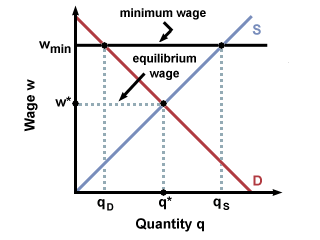
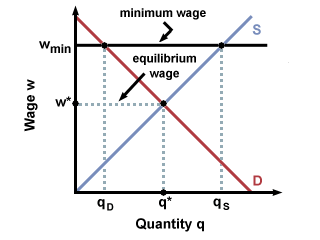
Okay, so the market for the good being produced has been severely depressed, raising the price hurting consumers. Within that market for the good, the high wage demanded by the unions causes firms to hire fewer workers because the wage demanded is well above the market wage for that work, causing a labor surplus – more commonly called unemployment. In other words, at such a high wage, many workers are willing to work for such a wage, but employers aren't willing to pay that high wage. As a result, the quantity of labor supplied (Qs) far exceeds the quantity of labor demanded by firms (Qd).

source (click to enlarge)

So we end up with a situation where firms demand less labor overall because they produce less. Of that labor that they do demand, firms are forced to hire even fewer workers than they otherwise would because of high wage. Those few workers that do get hired are much better off, but it comes at an enormous expense to consumers and other workers.

Thus, companies are not as profitable as they could be, goods that could and should be being produced aren’t, the average workers finds it much harder to find a job, and the result of all this is a significant hit to GDP. Unions very seriously hurt economic production. In short, unions make the individual workers better off at the expense of the companies, other workers and the general economy.

The free market is very capable of creating wealth for everybody without causing anybody harm. If left to its own devices the market would efficiently allocate goods and services and the collective self-interest of workers and firms would naturally contribute to the common good. Insert government intervention into the market, in whatever form (except for a very few special cases), including unions, and the market has gone from a non-zero sum game to very much a zero-sum game: people can only profit at the expense of others.

To further aggravate the problem, unions, in an attempt to maintain their illegitimate market share, resort to coercive tactics in other businesses besides their own. Take a plumbing company that is controlled by the unions. If another plumbing company wants to open up their business, they could gain a competitive advantage in the marketplace if they used non-union workers. Their cost of production would be much lower, thus they could charge lower prices, and thus they could siphon business away from the union company.

Since union workers are guaranteed a very high wage and they cannot be fired, they have no incentive to work hard and their production goes way down (to say nothing of the union-mandated breaks and strict labor rules, i.e. a painter can only paint. If he needs to take off a light-switch cover to complete his job, he has to wait for the electrician to come and remove it. If the painter did it, he would be “stealing” work from the electrician.)

Therefore since the new plumbing company can offer much more efficient service at a lower price, unless the unions take action, their company would go out of business and they would find themselves without a job.

Thus, the unions use coercive measures to get the new companies’ employees to unionize, or they lobby very heavily to get the laws changed in their favor. These laws could take the form of mandating companies to unionize, or it could be getting congress to pass some type of law that makes it impossible for the new company to enter the marketplace.

Related to this, unions remove the incentive to innovate. For a real-world example of this, read this article. Refer above the first graph that shows the supply curve shifting left because of the increased cost of inputs. Another reason the supply curve may shift is due to a change in technology. If we improve our technology, producers can produce more with less, thus lowering their cost of production, causing them to supply more at every price. This is reflected as a rightward (or downward) shift of the supply curve, which increases output and lowers the price. Union tactics, such as in the article referenced to above, prevent this shift. In a very real way, unions prevent the economy from advancing and moving forward.

The result of all this is reduced competition, lower quality work, a restricted labor market and depressed GDP. Unions are very damaging to the economy. Their actual results to the economy are exactly opposite of what they claim to do.

I understand that it’s not apparently obvious that unions cause so much damage. Once you’re inside, you’re blinded by the “glamour” of high wages and a secure job; of course you would fight to keep it.

One final point about high wages. The argument typically goes something like this: "If a worker has more money in his pocket, his standard of living is increased, he has more to spend and everybody becomes wealthier." Sounds nice; if only it were true.

Money or wages do not equal wealth. Production equals wealth. How are we as an economy any wealthier if the union worker has a lot of dollars in his pocket, but because of economic impact caused by unions, the price of goods is higher as well? In fact, the union worker getting an artificially high wage is actively harmful as it comes at the expense of the economy. Are we better off if we have more dollars in our pockets but our production has gone down?

The idea that money or wages equal wealth is a huge economic misunderstanding. Unfortunately this misunderstanding has been used to justify stimulus spending on public works projects, unemployment and minimum wage. Only production equals wealth and we need labor to produce things.

By unions restricting and depressing the labor market and by stifling innovation, much less is getting produced than otherwise would be causing us all (even union workers) to be poorer, not wealthier.

Wednesday, August 11, 2010

The Laffer Curve and Limited Government

Ezra Klein from the Washington Post had an interesting piece on the Laffer Curve and where the US currently sits on that curve.

For some background information, the Laffer Curve is an idea popularized by and named after economist Arthur Laffer. It basically says that as the tax rate rises, the tax base falls. Therefore the government can maximize revenue by striking just the right balance between tax rate and base.

Think of a standard bell-curve. On the vertical Y-axis is tax revenue, and on the horizontal X-axis is the tax rate. The top of the curve (maximum revenue) will be somewhere near the middle of the X-axis (before revenues start to fall with a higher rate).

In other words, a tax rate of 0% won’t raise any revenue because nobody would be paying taxes, and a tax rate of 100% would likely raise no revenue either because there would be no incentive to go to work because people wouldn’t be able to keep any of what they earn.

Therefore, as the tax rate rises, the number of people paying that tax declines. Some people might leave the workforce, move their operations out of the country, simply hide their earnings or practice other measures of tax avoidance.

The lesson here is that government might actually raise revenue if it lowered the tax rates.

So back to the article, Klein asks prominent economists, accountants and politicians where does the Laffer Curve actually peak and where does the US currently sit? Are we on the wrong side of the Laffer Curve?

The answers differ greatly, but I think Greg Mankiw’s answer is the best:

"My guess is that that the short-run answer and the long-run answer are
quite different. For example, if you raised the top rate from 35 to, say, 60 percent, you might raise revenue in the short run. Over time, however, you would get lower economic growth, so the additional revenues would fall off and eventually decline below what they would have been at the lower rate.... I will pass on offering a specific number, as it would require more time and thought than I can offer just now, but I will opine that I think the long-run answer is actuallymore important for policy purposes than the short-run answer."
As I have argued before, I think one of the greatest policy failures of government is being too focused on the short-run and therefore neglecting or even hurting long-run growth.

I also like Martin Feldstein’s answer, in that he addresses another often-neglected economic reality – deadweight loss:

"Why look for the rate that maximizes revenue? As the tax rate rises, the
"deadweight loss" (real loss to the economy rises) so as the rate gets close to maximizing revenue the loss to the economy exceeds the gain in revenue.... I dislike budget deficits as much as anyone else. But would I really want to give up say $1 billion of GDP in order to reduce the deficit by $100 million? No. National income is a goal in itself. That is what drives consumption and our standard of living."

Deadweight Loss, or excess burden, is the loss to the economy above and beyond the cost of the tax. Without a tax, the economy efficiently allocates resources. Consumer and Producer Surplus are maximized. Add a tax, and the tax incidence ensures that consumers pay a higher price AND sellers receive a lower price than they otherwise would – both parties lose out. This means that consumer and producer surplus no longer maximized because consumers are paying for a product or service that they are not receiving and producers are providing a product or service that they are not getting paid for.

Beyond just raising revenue, taxes come with an extreme backlash because the public doesn’t like having money forcibly taken from them. Even beyond this, the hidden costs to the economy are tremendous. As Feldstein states, it is very possible to cause $1 billion worth of damage to the economy to raise revenue by $100 million.

Taxes are necessary. There is no doubt about that. But because they come with such a high social and economic cost, it is imperative for government to be prudent and responsible. What does that look like? Well a prudent and responsible government is one that does its core functions well and nothing else. These core functions are:

Provide for the common defense;

Protect and enforce property rights;

Protect individual liberty;

Enforce freedom to contract;

Provide a criminal justice system;

Correct any market failures (i.e. monopolies, public goods and externalities).

Beyond these core functions, there is not much for the government to do; therefore the tax burden should be as minimal as possible. Remember, the government’s job is not to raise as much revenue as possible. The government’s job is to raise enough revenue to carry out its duties.

Therefore, to try to find where the Laffer Curve peaks and strive to get there may do much more harm than good because it may mean that government is involved in too many aspects of our lives and has greatly over-extended its reach.

Tuesday, August 10, 2010

Spain's Failed Economic Experiment

Spain’s program to put 2000 electric cars on the road by the end of 2010 has failed. So far, despite massive government subsidies to encourage sales, only 16 electric cars have been sold in all of Spain.

The government invested almost $1 Billion into the program, including giving subsidies of more than $7,800 to buyers. Despite heavy government propaganda, a very “green” friendly populous and massive subsidies, the program still failed.

Why?

The answer is because the cars still cost $31,400 even after the subsidy and there have only been 20 charging stations built across the entire country (only 1 in Madrid). These two factors combined make the price of owning one of these cars very expensive, a killer in tough economic times.

Spain is also cutting in half its massive subsidies it provides to firms willing to invest in solar technology in the country. Spain says it is cutting the subsidies in order to save money. It also says that cuts are justified because the subsidies have allowed the industry to grow and it can remain profitable on its own.

Half of that story is correct: Spain is going bankrupt by trying to steer its economy towards green energy. This is a laudable goal and alternate energy should certainly be encouraged, but bankrupting your economy in order to get there is clearly the wrong tactic, as is evidenced by Spain’s current troubles.

If solar electricity was so successful, the demand for electric cars would be evident. If the demand were evident, charging stations would pop up all across the country in order to cash in. Cars wouldn’t need to be subsidized in order to get sold.

Spain is conducting a valuable economic experiment that we can all benefit from by paying attention. The lesson? A government that tries to control the economy and force it off of fossil fuels before it’s cost effective to do so is a recipe for failure.

This is no longer a debate suitable only for theoretical ivory tower discussion. Spain has provided a real-world example (yet again) that you cannot stifle market forces, that a command-and-control type economy will always fail, and that by just throwing untold amounts of money at alternate energy does not necessarily make it viable.

Thursday, December 17, 2009

Another Job Killing Idea From Obama

This article from the Wall Street Journal is very dismaying.

Some quotes from an interview Obama gave to “60 Minutes” on Sunday.
“I did not run for office to be helping out a bunch of fat cat bankers on Wall Street,”

“You guys are drawing down $10, $20 million bonuses after America went through the worst economic year that it's gone through in -- in decades, and you guys caused the problem. And we've got 10% unemployment."
Obama just doesn’t get it. He is focused on some sense of class struggle and fairness more than getting the economy going again. The easy reaction is to look for someone to blame and divide the nation by pitting the “fat cats” against the “working man”. This is a false dichotomy and by making such divisive, negative remarks, Obama is ensuring that uncertainty, lack of trust, and downright contempt continue from both sides. Indeed there wouldn’t even be something like “both sides” if Obama stopped perpetuating it. No wonder banks aren’t lending.

Said one, “I am a CPA. My clients are unable or unwilling to jump through the ‘hoops’ the regulators have established. Hence they are just sitting on the sidelines rather than investing and creating jobs”

Uncertainty in the financial and business industry causes business to hunker down and wait it out. Obama increasingly talks about raising taxes on companies’ profits or cutting salaries that are tied to company performance. Why would any business take a risk by investing and hopefully turning a profit when all their benefits from doing so will be undercut by the government?

In the Great Depression FDR caused so much business uncertainty by constantly changing the rules and adding new regulations and oversights and taxes that it virtually killed business investment, thus prolonging the depression.

We’re seeing much the same thing happen now. No politician will ever see that it’s government causing the problem. Mr. Obama, it wasn’t the banks that caused the mortgage crisis, it was excessive regulations on the banks that forced them to lend to risky borrowers that caused the mortgage crisis.

Now, by removing all incentive for banks and big business to branch out, invest and hire more workers, and instead forcing them to lend when it doesn’t make financial sense to do so, you’re going to solve the problem? How can we solve a problem by repeating the very same mistakes that caused it? Does that make any sense?

Friday, December 11, 2009

Which Side Are You On?

"Which Side Are You On" by Florence Reece
Come all of you good workers,
Good news to you I’ll tell,
Of how that good old union
Has come in here to dwell.

Which side are you on?

My daddy was a miner,
And I’m a miner’s son,
And I’ll stick with the union,
Till every battle’s won.

They say in Harlan County,
There are no neutrals there.
You’ll either be a union man,
Or a thug for J.H. Blair.

Oh, workers can you stand it?
Oh, tell me how you can.
Will you be a lousy scab,
Or will you be a man ?

Don’t scab for the bosses,
Don’t listen to their lies.
Us poor folks haven’t got a chance,
Unless we organize.
I like this song. It's obviously pro-union, and I definitely don't support unions, but I do like the history lesson. This is a good illustration of why sometimes it's hard to implement sound economic policy, especially in times of trouble. When emotions are running so high, as they were when this song was written, it's almost impossible to talk people down and explain why unions might be economically damaging.

In the Great Depression, people were desperate for work and for money. In their desperation, they chose the most obvious path to secure jobs and high wages - unions. While it seemed like the right thing to do, it was probably one of the worst things they could have done.

It was around this time that unions started turning into the type of organizations we know today. They were given collective-bargaining power by the government and started using strikes and coercive tactics to accomplish their goals. By demanding higher wages than was justified by the economy, they severely weakened their companies' profitability which limited growth and job-creation. Also, by raising the wage above the market rate, businesses demanded less labor. So while the goal of unions was to secure jobs, and it accomplished this for a select few, all they really accomplished was to curb employment and limit companies' growth, helping to prolong the depression.

In times of perceived crisis we must be extra-vigilant and guard against emotion-driven policies that, when scrutinized, don't hold up economically.

Thursday, December 10, 2009

The Case For Private Schools

Educating our children is one of the most important responsibilities we have. The benefits of education are very clear. In developing countries virtually any effort to help would be moot if that society doesn’t receive education first. Women in our society and around the world are breaking out of their submissive roles and proving that they have something to contribute. People who try to control and exploit women and children argue vehemently against education because they know it’s a path to freedom.

In our society education is often seen as a “positive externality” – something that one person has or does that has positive spillover benefits to the rest of us. The evolution of our economy from agriculture to manufacturing to technology and services could not be possible without education. It’s pretty easy to argue for increased education and the benefits that come with it and there are very few that need convincing.

Therefore, it now seems logical to not argue for education, but rather to argue the best way to go about educating our children.

Public schooling in this country has had support from the very beginning, including such famous supporters as Thomas Jefferson, Noah Webster, Benjamin Rush and George Washington. These men believed that education was so important that it should be free, available to every child regardless of circumstances, and absent religious coercion. Despite this early and formidable support, public education did not make it into the constitution.

Many state constitutions specifically call for public education, but it wasn’t until 1918 that at least elementary school enrollment became compulsory. Oregon passed a law in 1922 saying that all children must attend public school and private schools would no longer be allowed to operate. The law was appealed to the Supreme Court as Pierce v. Society of Sisters and was unanimously ruled unconstitutional.

The Opinion of the Court was delivered by Justice James Clark McReynolds:
“We think it entirely plain that the Act of 1922 unreasonably interferes with the liberty of parents and guardians to direct the upbringing and education of children under their control: as often heretofore pointed out, rights guaranteed by the Constitution may not be abridged by legislation which has no reasonable relation to some purpose within the competency of the State. The fundamental theory of liberty upon which all governments in this Union repose excludes any general power of the State to standardize its children by forcing them to accept instruction from public teachers only. The child is not the mere creature of the State; those who nurture him and direct his destiny have the right, coupled with the high duty, to recognize and prepare him for additional obligations.”
Okay, now that we have a little history out of the way, let’s look at the real issue, the one that has been raging before and after the Supreme Court case just mentioned. Which is better, public school or private school? They both have their merits and they both have their drawbacks. On the whole, it is my opinion that private school provides the most quality education, provides the best choices and makes the most economic sense.

Before I make my case for private school, let me lift up an area where public school provides a valuable service that private school cannot – integration. I think it’s good for kids to be exposed to people that are different from them. In public school, kids and parents have no choice in where they go to school, except of course by selecting what school district to live in. In public school kids will be taught alongside those of other races, religions, creeds, languages and socio-economic backgrounds. It’s a good life experience to learn from and listen to those that are different than us.

Private school, on the other hand, runs the risk of isolation. Since parents will choose what school they want their kids to go to, they will choose on that reflects their own values. As such children of religious parents will go to religious schools, children of atheistic parents will go atheistic schools, etc. This opens the door to extremism, narrow-mindedness and possibly even xenophobia. While those dangers are certainly a possibility, I think the reality of their fruition is very slight. On the whole, the benefits of private school largely outweigh their costs.

With private school (or charter schools) parents have a choice in where to send their children. They do not have to accept being stuck at a failing school with failing teachers. If they feel their child is not getting an adequate education, they can simply change schools. If a school is failing, enough parents will pull their children out and that school will be forced to shut down due to lack of tuition. Failing schools should be allowed to fail, not be continually propped up with tax-payer dollars.

The quality of teachers and curriculum would be greatly increased if we went exclusively to a private or charter school system. Once schools have to start competing with each other, the race will be on to attract the best, most qualified teachers. You will see teachers’ salaries spiral upwards as good teachers suddenly become in demand and bad teachers are no longer able to find jobs. The increase in wages will attract other intelligent and capable people into the field of teaching; an area they might overlook now because of the low pay and poor working conditions.

Those schools that have the best teachers will attract the most students. If one school becomes too in-demand that it can justifiably raise its tuition rates, another school will pop up with lower tuition in an effort to compete. This constant competition among schools will keep teachers’ salaries high and tuition low.

Also, similar with colleges, you will see private schools recruiting. Having the best students reflects well on them so the incentive is there to offer free bussing, scholarships, and other perks like tutoring. And nobody will be left out. Since students will now be paying customers, it wouldn’t be in a school’s interest to deny enrollment. If there is a block of students that cannot be accepted into the “elite schools,” there is still demand for their education. In the private sector, if there is a demand, a service will be provided to meet it.

There are many teachers that enter the profession to teach the “unteachables.” These great men and women willingly accept the challenge of teaching those children to whom learning does not come naturally. These teachers will gravitate and be recruited by schools that will specialize in that type of education. For those children that need extra help, they will get much better schooling and much more needed attention in private or charter schools than they will in public school.

And it doesn’t have to be specialized or elite schools that enter the business. There will be schools that fit neighborhood demand or cater certain localities just like our public schools do today. The only difference is you can be assured the school will be of very high quality.

Now, compare this outcome with that of our current public school system. Public schools obviously aren’t socialist, but in many respects they have the same drawbacks as with any socialist system.

In public schools, there are no prices (tuition) to send signals. With private schools, those schools that are charging a higher tuition do so as a reflection of increased demand. The increased demand comes from a quality service provided. Because parents have very little choice in where to send their kids, they cannot “vote with their feet” if they feel a school is failing. In private schools, the market is able to send signals as to which schools are failing and which schools are thriving. These signals come in the form of tuition rates and whether the school is attracting or losing students.

Public school, on the other hand, has no such signals. Schools are in no danger of going out of business because they are paid for by the state and therefore don’t have to worry about losing money. Also, parents don’t really have a choice in sending their kids somewhere else so public schools are virtually guaranteed students, even if they are terrible. These two facts (guaranteed money and students) work to remove the incentive for public schools to increase their performance and also ensure that failing schools are allowed to continue failing.

Now obviously every teacher and principal (well, most) wants to do well and increase their performance and quality. The problem is that the system is constructed in such a way that it’s impossible to gauge if you’re doing well or not. Because there are no free-market signals, public schools must rely on aptitude and other scholastic tests to measure the performance of their students.

Obviously testing students is a good thing, but not when it’s your only measure to gauge success. Since it’s public schools’ only option, what happens is that schools start “teaching to the test”, with their only aim to pass the test to ensure they receive continued funding. This is a perverse incentive. The true aim of schools should be a comprehensive education, not to tailor it some way the state deems appropriate, with the goal being, not education, but securing more money.

Remember Justice McReynolds’ quote from Pierce v. Society of Sisters, “The child is not the mere creature of the State.” When the state creates the tests, and says you must teach the children is such a way that they pass this test, you’ve created a potentially dangerous situation.

Also with public schools, and related to the performance-gauging problem, we end up with strange legislation like “No Child Left Behind.” All this legislation did was cement the fact that schools had to teach to a state-written test, but left it up to the schools themselves to set the benchmarks. This created the incentive to set the benchmarks very low so that they’re easily met. All of these results in children being taught to a test – a test that isn’t at all rigorous, challenging, educational, or intellectually stimulating. Clearly a losing situation.

Okay, so how do we go about achieving this vision of all private or charter schools? Really, not much has to change. Property taxes are largely based on what school district you live in. This can be amended so everybody everywhere pays a flat property tax (instead of it being higher or lower depending on the school district).

Government will take this tax revenue, and instead of giving it directly to schools, will give it to the parents in the form of a voucher. The parents can use this voucher toward tuition at any private or charter school they want. The schools still get their revenue, even poor families will still be able to attend private school, the government will be able to say it helped, failing schools will go out of business, quality of education and teachers salaries will spiral upwards and economic principles and liberty will be maintained. Private schools are truly a win for us all.

As an aside, here is a very intersting report from the Cato Institute very clearly shows how the public school dilemma cannot be solved simply by "throwing money at it."

Wednesday, December 9, 2009

Meaner, Greener EPA

Once again, by not following economic principles, the government has made us worse off. The EPA announced on Monday that carbon was a gas that was dangerous to people’s health. This opened the door to them being able to mandate carbon emissions through taxes, regulations, and command-and-control practices.

Basically what happened is this: cap-and-trade legislation is stalled in the Senate and might not pass at all. Instead of accepting defeat or re-working his proposal in a more pragmatic manner, President Obama has found a way to bypass congress and try to accomplish his climate change vision anyway. Only this is much worse than a cap-and-trade bill.

As I've argued before, cap-and-trade, at its heart, is economically sound. The reason behind cap-and-trade has nothing to do with climate change and it’s unfortunate that this administration has hijacked it for that purpose. The current legislation proposing cap-and-trade strays from the economics behind the idea, but it’s definitely better than the alternative – an expanded and more powerful government agency.

If politicians and the American people could see cap-and-trade for what it was, and implement it in the proper way – not some perverse way that’s distorted by partisan politics (i.e. handing out carbon permits to political allies) – then this EPA threat would go away.

It’s unfortunate that Obama would resort to such barbarian tactics such as threats, circumventing the political process and advancing a political agenda against the wishes of the country. So I regret that we’ve been painted into this corner of “pass cap-and-trade or else”, but in light of the circumstances, the best bet would be to pass the cap-and-trade legislation.

As I've argued before, cap-and-trade is a good thing – from an economic standpoint; only bad things have resulted once it got dragged into a political fight. So hear this. If you were against cap-and-trade because you thought it would be a business killer, the expanded EPA will be much worse.

Cap-and-trade creates property rights and curtails pollution at the least possible cost with no taxes and very little government involvement. The Meaner Greener EPA will use taxes, regulations, command-and-control and massive oversight to accomplish its goal, which won’t be at lowest cost and will still result in less pollution reduction than cap-and-trade.

Cap-and-trade is an economists’ solution to pollution. The EPA is a politicians’ solution to pollution. I have previously written why economists are ignored by politicians. Let’s not now shun cap-and-trade only to be hit by the much worse and more damaging EPA.

Tuesday, December 8, 2009

An Economic Look at Obama's Job Speech

Obama gave a speech today about job creation and what he was going to do with the excess TARP funds. Let’s look at this speech with an economic eye:

“The fear among economists across the political spectrum was that we were rapidly plummeting toward a second Great Depression.

“So, in the weeks and months that followed, we undertook a series of difficult steps to prevent that outcome. And we were forced to take those steps largely without the help of an opposition party which, unfortunately, after having presided over the decision-making that led to the crisis, decided to hand it over to others to solve.”
What political pettiness.

“To achieve this, and to prevent an economic collapse, we were forced to extend assistance to some of the very banks and financial institutions whose actions had helped precipitate the turmoil.”
Because those banks were forced to lend, by the government, to unqualified applicants they never would have lent to on their own.

“These were not decisions that were popular or satisfying; these were decisions that were necessary.”
Maybe to a politician such as yourself, Mr. Obama, in your incessant need to “dosomethingdosomethingdosomething,” but to most economists, they most definitely were not necessary.

“This fall, I signed into law more than $30 billion in tax cuts for struggling businesses, extended an effective tax credit for homebuyers, and provided additional unemployment insurance for one million Americans.”
I cut taxes, then immediately raised them to pay for all this government assistance.

“In addition, we are working to break down barriers and open overseas markets so our companies can better compete globally, creating jobs in America by exporting our products around the world.”
Oh, is that what it’s called when you impose a 35% tariff on imported tires from China?

“Partly as a result of these and other steps, we're in a very different place today than we were a year ago.”
We are in a different place. We’re worse off.

“This is welcome news, and news made possible in part by the up to 1.6 million jobs that the Recovery Act has already created and saved according to the Congressional Budget Office.”
Job created or saved: temporary jobs, part-time jobs, and seasonal jobs. Our underemployment rate is as high as it’s ever been (those who have a part-time job but are looking for full-time work). Temporary jobs count too. I can find a one-day job moving rocks and it counts as a job created. If I find a different one day job the next day it counts as a job created. ARRA is not created or save 1.6 million jobs the way he wants you to believe it has.

“For even though we have reduced the deluge of job losses to a relative trickle, we are not yet creating jobs at a pace to help all those families who have been swept up in the flood.”
Because the government can’t create jobs! Only the private sector can do that. Businesses need a stable environment in which to flourish. A constant clear message of low taxes and a hands-off government are what are needed. By your constant meddling Mr. Obama, you’re only creating and sustaining uncertainty – the ultimate job killer.

“There are more than seven million fewer Americans with jobs today than when this recession began.”
Recessions hurt. The market needs to self-correct. By trying to interfere, you’ve, paradoxically, only made the problem worse.

“And it speaks to an urgent need to accelerate job growth in the short term while laying a new foundation for lasting economic growth.”
Unsustainable empty subsidized job growth is not the way to lay a foundation for lasting economic growth.

“We're proposing a complete elimination of capital gains taxes on small business investment along with an extension of write-offs to encourage small businesses to expand in the coming year.”
Now, just so you don’t think this piece is only to bash Obama, I like this idea. This blog does not follow politics. It follows economics. As such, we will follow the economics whether it takes us left or right. This as it happens, is more of Obama going right than us going left, but the fact remains that we support it. However, Obama must be careful. A tax cut here and a tax cut there will not be effective if the overall business environment is one of high taxes and high regulation.

“We're proposing a boost in investment in the nation's infrastructure beyond what was included in the Recovery Act… What this means is that we're going to see even more work - and workers - on Recovery projects in the next six months than we saw in the last six months.”
It didn’t work the first time, so let’s double down.

“I'm calling on Congress to consider a new program to provide incentives for consumers who retrofit their homes to become more energy efficient.”
This is another good idea and one where perhaps the economics takes us left. I have previously defended cap-and-trade (though not in the context of global warming) and I now defend this idea. Making your home energy efficient has, in my opinion, qualities of a positive externality. That is, it provides benefits beyond those explicitly for the homeowner. By putting in energy efficient windows, it reduces your overall power consumption, reducing demand, and thus bringing prices down for everybody. Because positive benefits spillover to other people, this type of behavior should be encouraged. A government subsidy accomplishes this.

“These steps provide a framework in which companies can compete and innovate to create those jobs.”
Government subsidized job growth does not foster competition. Raising tariffs in order to keep high domestic prices on tires so those workers don’t lose their wage does not foster competition. The words “government” and “competition” are mutually exclusive Mr. Obama.

“There has rarely been a less loved or more necessary emergency program than TARP, which - as galling as the assistance to banks may have been - indisputably helped prevent a collapse of the entire financial system.”
More political hyperbole and fear mongering. It was not one of the most necessary government interventions in history. I understand TARP was Bush’s idea, and I was just as critical of Bush for proposing it as I am of Obama for defending it.

“Launched hastily under the last administration, the TARP program was flawed, and we have worked hard to correct those flaws and manage it properly.”
More political pettiness. That’s quite off-putting Mr. Obama. And I would quarrel with you that you have managed it properly.

“And today, TARP has served its original purpose and at a much lower cost than we expected.”
But since we never met a tax dollar we didn’t like, instead of giving back it to the taxpayer, we’re going to use it further fund a failed ARRA program.

“For even before this period crisis, much of our growth had been fueled by unsustainable consumer debt and reckless financial speculation, while we ignored the fundamental challenges that hold the key to our economic prosperity.”
So we’re going to repeat the same mistakes that caused it by needlessly intervening in places the government has no business.

“We cannot go back to an economy that yielded cycle after cycle of speculative booms and painful busts.”
By “saving” the economy from a necessary correction, you’ve only delayed the inevitable. The economy cannot be propped up by the government forever so another crash will be necessary. Then government will “save” us again, thus necessitating another crash. You’re exactly right Mr. Obama; we cannot go back to a government-intervention-caused boom-and-bust cycle. Stay out of the way.

“We cannot continue to accept… a health care system in which exploding costs put our businesses at a competitive disadvantage.”
I agree. Abandon Medicare and Medicaid, roll back interventions in the healthcare market, enforce anti-trust legislation and let economic principles be your guide. Your current healthcare ideas will only compound a problem you yourself (government) created.

“Because an educated workforce is essential in a 21st century global economy, we've launched a competitive Race to the Top fund through the Recovery Act to reform our schools and raise achievement, especially in math and science.”
Because there is not a problem in the world that can’t be solved by throwing money at it.

“Because even the best trained workers in the world can't compete if our businesses are saddled with rapidly increasing health care costs, we're fighting to do what we have discussed in this country for generations: finally reforming our nation's broken health insurance system and relieving this unsustainable burden.”
I admire you for wishing for reform Mr. Obama, but the key to reform is a more free-market based approach and less government intervention.

“We'll set and enforce clear rules of the road, close loopholes in oversight, charge a new agency with protecting consumers, and address the dangerous, systemic risks that brought us to the brink of disaster.”
By “address the dangerous, systemic risks that brought us to the brink of disaster,” you mean you will point the finger at yourself (government) right? Banks and lenders only played by the rules the government set out. By creating perverse incentives, you got perverse results.

“And because our economic future depends on our leadership in the industries of the future, we are investing in basic and applied research, and working to create the incentives to build a new clean energy economy. For we know the nation that leads in clean energy will be the nation that leads the world. I want America to be that nation.”
And I want a teleporting recliner that makes pizza, but wishing won’t make it happen. I admire encouraging research, but to expect to transform our entire economy simply by throwing money at it is naïve. Green technology won’t become the norm until there is a real demand for it – not artificial demand created by government funding.

“There are those who claim we have to choose between paying down our deficits on the one hand, and investing in job creation and economic growth on the other. But this is a false choice.”
I agree, it is a false choice. Very few with economic understanding would ever think that creating unsustainable empty jobs at taxpayer expense is a wise choice.

“One of the central goals of this administration is restoring fiscal responsibility. Even as we have had to spend our way out of this recession in the near term, we have begun to make the hard choices necessary to get our country on a more stable fiscal footing in the long run.”
HA! Massively increasing spending only to even more massively raise taxes is not fiscal responsibility and it is certainly not putting us on stable fiscal footing.

“Despite what some have claimed, the cost of the Recovery Act is only a very small part of our current budget imbalance. In reality, the deficit had been building dramatically over the previous eight years.”
It’s Bush’s fault.

“The fact is, we have refused to go along with business as usual;”
More like, “The fact is, we have refused to go along with business. As usual.”

“And I made clear from day one that I would not sign a health insurance reform bill if it raised the deficit by one dime - and neither the House nor Senate bill does.”
The massive increase in spending that is necessary in this bill will be paid for by even more massively increasing taxes. You’ve proven yourself spend happy Mr. Obama. You’ve never met a tax dollar you didn’t like so why should we believe you that you won’t spend the extra tax revenue on even more social programs? You’re doing it right now with the excess TARP funds. Instead of giving it back to the taxpayers, you’re putting it into ARRA.

“And the question we'll have to answer now is if we are going to learn from our past, or if - even in the aftermath of disaster - we are going to repeat it.”
You’re doing everything necessary to ensure we repeat it. Government intervention creates more problems than it solves. Yes, we are definitely going to repeat our mistakes.

“As the forces of the status quo marshal their resources, we can be sure that answering this question will be a fight to the finish.”
It seems to me the status quo has been ever-expanding government, regulation, and the curtailing of liberty. It seems to me it is you who is fighting to maintain the status quo, Mr. Obama.

Monday, December 7, 2009

An Economic Poem

"One From One Leaves Two" by Ogden Nash

Higgledy piggledy, my black hen,
She lays eggs for gentlemen.
Gentlemen come every day
To count what my black hen doth lay.
If perchance she lays too many,
They fine my hen a pretty penny;
If perchance she fails to lay,
The gentlemen a bonus pay.

Mumbledy pumbledy, my red cow,
She's cooperating now.
At first she didn't understand
That milk production must be planned;
She didn't understand at first
She either had to plan or burst,
But now the government reports
She's giving pints instead of quarts.

Fiddle de dee, my next-door neighbors,
They are giggling at their labors.
First they plant the tiny seed,
Then they water, then they weed,
Then they hoe and prune and lop,
They they raise a record crop,
Then they laugh their sides asunder,
And plow the whole caboodle under.

Abracadabra, thus we learn
The more you create, the less you earn.
The less you earn, the more you're given,
The less you lead, the more you're driven,
The more destroyed, the more they feed,
The more you pay, the more they need,
The more you earn, the less you keep,
And now I lay me down to sleep.
I pray the Lord my soul to take
If the tax-collector hasn't got it before I wake.

Sunday, December 6, 2009

A New Economic Understanding in the Military?

MIT wins $40,000 prize in nationwide balloon-hunt contest

Ala F.A. Hayek, the value of de-centralized knowledge is everywhere. The military was offering $40,000 in a contest for the first team to find 10 red weather balloons scattered around the country.

The contest is open to anybody and everybody and the rules are very simple: be the first to submit the coordinates for all 10 balloons and you win. How can one person possibly find all 10 balloons, scattered around the country? The answer is they can't.

No one person will be able to acquire all the knowledge necessary in order to solve the problem. Each person will be forced rely on other people's knowledge, the internet, cell phones, GPS, etc. In other words, all the information is out there, but is scattered amoung thousands or millions of people and the technology they have built.

This is fun game that illustrates the power and the necessity of dispersed knowledge. This is an invaluable economic lesson. No one person can be expected to have all the knowledge necessary to run an economy. No government could possibly know everything possible to "plan" an economy.

Our market works because I do what is in my interest and you do what is in yours, and our neighbors do what are in theirs. All of us working in our own best interest magically comes together to promote the interest of us all. As Adam Smith famously said,
"It is not from the benevolence of the butcher, the brewer, or the baker that we expect our dinner, but from their regard to their own interest."
For a short, excellent illustration of this idea, I highly encourage reading, I Pencil by Leonard E. Read. I also highly encourage reading Hayek's seminal work, The Use of Knowledge in Society.

Saturday, December 5, 2009

Another Bad Idea on Healthcare

The Senate is set to vote on key aspects of the proposed healthcare bill. Specifically what they are voting on is whether or not to partially fund the bill by decreasing Medicare funding by $460 billion. The Democrats say this proposal wouldn’t hurt Medicare because it would simply eliminate waste and inefficiency from the system.

I don’t understand how these people think. It is truly beyond my comprehension how anybody can think this healthcare bill is a good idea. Even the most basic understanding of economics shows that it’s a terrible way to go about healthcare reform.

I have previously written about the massive failings of Medicare, and how much of our current problems with increasing prices and dropped coverage stem from this broken, socialist system. Now, their solution is to fix the problem that Medicare caused by making Medicare even worse.

This is just another example of government repeating its same mistakes. How on earth could we fix the problem by repeating the same mistakes that caused it in the first place? Not only does this current legislation seek to repeat the same mistakes, it actually aggravates them.

Medicare is already broken. It’s an inherently flawed system – something that can’t be fixed just by giving it more money. Simply providing more money doesn’t do anything to change the backwards incentives it creates nor does it change the inefficient, complex central planning that is inherent is such a program. So while Medicare can’t be fixed by getting more money, our healthcare system as a whole can be made even worse by cutting even more money from Medicare.

Already the reimbursement rates and formulas are inadequate, and to try to keep the system alive while cannibalizing it makes no sense. This bill is economically backwards and will do absolutely nothing to reform healthcare. It takes the lazy route by trying to address only the symptoms of a broken healthcare system, while completely ignoring the causes.

For true healthcare reform, in a way that will actually work, which includes eliminating Medicare and Medicaid, click here. We have all become so caught up in the details of Obama’s ideas for healthcare reform that we never stop to think if it’s the right kind of reform. Opponents to this bill are immediately labeled as anti-reform. That is absolutely not true. Instead we are trying bring some semblance to conversation and not rush hastily down a dead end street, but instead recognize there are other ways to go about reform that don’t include an eventual government take over.

You can craft the straightest, most perfectly designed arrow, but it will never hit its target if it’s shot in the wrong direction.

Friday, December 4, 2009

Senator Bennet Has Gone Rogue

Colo. Sen. Bennet Says He'll Vote for Health Care Bill, Even if it Costs Him His Job

This article is shocking enough on its own, so there is really not much more to say on it. When a politician so blatantly ignores his role as representative of the people, it’s time we all take notice. I suspect politicians have long voted their conscience regardless of the will of their constituents, but at least they play the game. Bennet blatantly disregards the political process and the integrity of our Constitution.

If the process works like it’s supposed to, those holding elected office represent the will of their constituents, otherwise they wouldn’t have been elected. This whole process breaks down when one is appointed to the position. Bennet was appointed to his seat by Colorado Democratic Governor Bill Ritter after Senator Ken Salazar, also a Democrat, was appointed as Secretary of the Interior by Barack Obama.

It obviously frustrates me when a politician not of my liking makes it into office. That is even worse when he was appointed rather than elected. Now, if I’m being fair, I suppose Governor Ritter did the right thing by appointing a Democrat to fill a seat vacated by a Democrat. Except for a few pockets, Colorado is largely Republican, yet it’s represented by a Democratic Governor and two Democratic Senators.

The political temperature in Colorado is clear: they do not support the Democrats agenda. I will make a prediction now that Governor Ritter and Senator Bennet will be replaced by Republicans in the midterm elections.

So what we have is a Senator who was not elected and does not represent the will of the voters, making decisions on behalf of Colorado. It’s not like he’s acting benevolently either. He understands and accepts the consequences that he will probably lose his Senate seat for this. This is a shame and an outrage.

The process of appointing representatives to fill vacant seats has always bothered me. I suppose to mitigate the chance of situations like this from happening again, Senators who are appointed should not allowed to vote until, and if, they get elected in the next election. I recognize this isn’t an ideal solution, but the way I see, it’s either that or have elections immediately following a vacancy (but that’s not ideal either because it might be too fast to run an adequate campaign).

Both options I present aren’t perfect, but I think they are better than having an appointed official making decisions that the people don’t agree with. The will of the people must be maintained at all costs. Article I, Section III of the Constitution calls for Senators to be appointed by their state legislature. The 17th Amendment replaces this system with direct election of Senators by popular vote, but it still allows the governor to appoint senators in case of vacancies.

It’s a problem when this system is abused. Senator Bennet is taking advantage of his appointment to advance a personal agenda, doing exactly what the Founders feared – abusing power.

I’ll leave you with this thought: It’s unfortunate that this is happening on an issue I am vehemently opposed to – government takeover of healthcare. But even if it was a Senator whose views were in line with mine that said no matter what he would vote his own way, regardless of the will of the people, I would be just as outraged and would vote him out the first chance I got.

This issue is above partisan politics. It’s about maintaining the integrity of democracy and our Constitution.

Thursday, December 3, 2009

Paul Krugman- Wrong Again

Paul Krugman never ceases to amaze me. I’m convinced he masquerades as an economist hoping to give himself some legitimacy. He might convince the ignorant, but those of us that actually understand economics know him as an economist in title only. No self-respecting economist would ever argue for the economically backwards “solutions” to problems that Krugman does.

In his article, Krugman argues that not enough has been done to save jobs and that nobody in Washington seems to care about unemployment anymore now that the worst of the recession seems to be behind us. I’ll agree with him on one point: the stimulus didn’t work.

Krugman seems to believe that it didn’t work because it wasn’t big enough – not big enough! No Mr. Krugman, the stimulus didn’t work because artificially created demand is a band-aid fix at best. In Krugman’s world, the best fix would be to pass a second, larger stimulus package. That is insanity! He does, at least, accept the fact that a second stimulus seems to be a political impossibility.

As most politicians do (for that is the only way we can view Krugman), he seeks to address the symptom instead of the cause. He proposes a New-Deal-type workers program that would amount to nothing more than digging holes only to fill them again. This is no way to talk about job creation. That type of government program is the economic equivalent of empty calories – they might seem tasty but they will never fill you up, and instead, only make you unhealthier.

A second “solution” Krugman offers is government-provided subsidies to employers to hire more workers. Let’s think about this for a second regarding what incentives it creates. A subsidized worker is cheaper for the employer to hire. Why would he keep his expensive employees that he must pay full price for when he can hire cheaper employees whose wages are subsidized by the government? I’m afraid a very real consequence to Krugman’s idea would be that employers fire at least as many workers that they hire on (if not more).

Krugman has the gall in his article to imply that, if we don’t implement his ideas, we are being cruel and short-sighted. Krugman, a Keynesian interventionist, is calling us short-sighted? That’s the pot calling the kettle black.

One of the biggest complaints I have with Keynesian economics is the short-sightedness of it. By continually intervening and preventing the market from self-correcting, we are doing nothing but perpetuating the problem, ensuring it’s never fixed! Short-term and empty job creation that is unsustainable and does nothing to address the underlying cause is what’s short-sighted, Mr. Krugman.

Krugman casually dismissed tax cuts as ineffective and not really worth talking about. Instead he argues for any number of programs that will have to be funded by increased taxes. He goes beyond dismissing tax cuts and actually argues for tax increases – in a recession!

Income tax cuts would give the worker more money to buy goods and services which would increase the demand for workers. If they didn’t spend their extra money, they would save it. Savings necessarily fuels investment, which is critical for growth.

There are those who argue that cutting taxes would only lead to a greater deficit. So what? Deficits are not nearly the nasty beast they’ve been made out to be. The Great Depression was aggravated because the federal government sought to preserve a balanced budget, which meant they needed to raise taxes and cut spending – both bad options in times of economic trouble.

In any case, the responsibility to prevent a deficit is not on the taxpayer. This idea that the government can spend freely and then simply keep on raising taxes to cover the deficit is absolutely inconsistent with our founding ideals.

The burden is on the government to spend as little as possible, and only spend on those areas that are legitimately governmental – providing national defense, protecting property rights, providing a criminal justice system, enforcing contracts, and ensuring economic integrity is maintained (accounting for market failures, i.e. monopolies, public goods and externalities). Beyond these core responsibilities of government, there is not much for them to do. We as citizens have a duty to pay the taxes that are necessary to fund the government that we created.

But for the government to spend recklessly and then look to us to pay for it is backwards. The burden is on the government to not out-spend revenue, not on us to ensure that we pay for everything they want to do.

If government didn’t have the blank check that it does now, it would never have the means or capacity to intervene in every aspect of our lives and the economy. If government never intervened, many of the problems we face today never would have been created. It is excessive government intervention in the market that causes most recessions, and if it doesn’t cause them, it definitely prolongs them.

Yes, tax cuts are the more responsible, sustainable and economically sound solution to our problems. It addresses the underlying cause and it’s consistent with liberty and the founding ideals of our country.

In case I haven’t convinced you, consider this example on why stimulus spending will never be successful in maintaining jobs.

By pumping so much liquidity into the market, inflation is almost sure to rise (especially so when you couple it with loose monetary policy and seignoirage that we're currently experiencing).

So, we can reasonably expect high inflation in the near to mid future. Inflation and employment are necessarily economic trade-offs. If unemployment rises, inflation falls. If inflation rises, unemployment falls. This is known as the Phillips Curve.

So, assuming jobs were actually created by this spending, we've effectively traded more jobs for more inflation. So far so good. I think everybody would say that's a fair short-term trade off.

So after unemployment returns to its natural rate, people will want to bring down the high inflation. To bring down inflation, GDP must be sacrificed (called the sacrifice ratio).

Typically about 5% of GDP must be "sacrificed" to bring down inflation by 1%.

Okun's Law tells us that a 1% change in unemployment results in a 2% change in GDP. Putting this all together, a 1% reduction in the inflation rate requires a 2.5% rise in unemployment. The higher inflation goes, the higher is the unemployment that's required to bring it down. The higher unemployment goes, the greater the drop in GDP.

For example, if we want to bring down inflation by 4%, we would need to sacrifice 20% of one year’s GDP and unemployment would have to rise by 10%. This all doesn't have to happen in one year. It can be spread out over 5 years of a 4% reduction in GDP and a 2% rise in unemployment.

So what has the stimulus actually accomplished? It may have created some jobs (a dubious claim), but in the not-so-near future those jobs will have to be lost and GDP will have to be sacrificed for inflation to come down. And you know what it's called when GDP shrinks instead of grows? A recession!

This stimulus money was maybe a flicker of light in the darkness, but its long term effects will be nothing but prolonging the recession it was meant to save us from.

Wednesday, December 2, 2009

Funny Yet Serious

I found this cartoon on Greg Mankiw's blog:
(Click to enlarge)


source: http://www.slowpokecomics.com/

In all seriousness, I don't blame Obama for winning the Nobel Peace Prize. I do blame him, however, for accepting it. The Nobel committee and Obama worked in concert to undermine the value of such an important prize.

The real shame in the whole matter, was that Morgan Tsvangirai of Zimbabwe, did not receive the prize. Tsvangirai was instrumental in breaking Robert Mugabe's deadly stranglehold on their country.

In Zimbabwe there is still a lot of work to do, but Tsvangirai has been instumental in effecting positive and peaceful reforms - despite Mugabe's best efforts.

Thanks to Tsvangirai, Zimbabwe finally has a glimmer of hope for the first time in generations. It's unfortunate that his positive influence and efforts have gone without the recognition they deserve because the Nobel Committee and Obama politicized an award that could - if given the chance - carry real weight toward positive humanitarian reform.

Tuesday, December 1, 2009

Realism vs. Idealism

President Obama believes in a good thing: diplomacy. He believes America has been too arrogant in years past and that arrogance has gotten us where we are today. He believes that if he replaces the traditional American attitude of “we’re the boss,” with a new attitude of “what do you think?” that all will be made well. Like I said, Obama believes in a good thing. Believing in Santa Clause is a good thing too, but we would be foolish to think it would change the world.

Obama thought that the way our enemies and rivals viewed us was justified. He thought that if he could just schmooze them with a little Obamalove, that all would be forgiven and we could all live happily ever after. So far, his relations with the rest of the world have been barely more than him saying, “I’m sorry for the way we’ve acted. How can I make it up to you?”

The unfortunate truth is that we live a world of realism. When Obama takes a step back as a concessionary gesture, our rival takes a step forward. The power we give up by striving for reconciliation is gained by those seeking to undermine us. In short, we live in a zero-sum world.

Obama is operating under the assumption that if he draws back and presents America as a more passive nation, then other nations will also draw back. This theory sounds very appealing and it’s hard to blame Obama for pursuing it, but blame him I will.

By granting concessions, Obama sees himself as extending an olive branch. He assumes that other countries will accept the gesture of peace and respond in kind. Obama envisions a grand bargaining table where everything can be hashed out if only America stopped trying to tell everybody else what to do. Again, this sounds noble and on its surface it’s very appealing. But as president, Obama has a responsibility to look beyond surface illusions. We, as the people, have a responsibility to look beyond surface illusions.

The “Can’t we all just get along?” approach is the easy way out – which would be great if other countries played along. But they don’t. Now don’t get me wrong, I’m entirely for diplomatic solutions. In fact, that’s the only type of solution that will ever be possible. Two sides can trade bullets all day long, but nothing will ever be solved until they actually sit down and talk.

I blame Obama not for his diplomatic intentions, but rather I blame him for neglecting to run the race and instead going straight for the finish line.

When Obama changed tactic on the missile-defense shield in Poland and the Czech Republic, he thought he was giving a concession to Russia in the name of goodwill. He thought that that gesture of goodwill would be returned by Russia agreeing to pressure Iran to halt its nuclear program.

Instead, Russia must have listened when Obama took office and starting basically telling the world, “I’m sorry, it’s all our fault.” Russia viewed Obama’s concession on missile defense as something it was owed, not as a gesture of goodwill. Obama, in Russia’s mind, had simply taken a step in the direction of repayment. If Obama wanted Russia’s help regarding the Iran issue, he would have to deliver a big offering, namely the U.S. dropping its support of Ukraine and Georgia.

Obama had hedged his bets on Russia. If he can’t get Russia to play along, he will be exposed for the paper tiger that he is. As such, the pressure is enormous to get Russia on board. Unfortunately, the only way to do that is to cede them a massive amount of power – something that is clearly not in our interest.

By blinking on the missile defense issue, Obama has shown that he is weak. Russia has him right where they want him – as a pawn that must bend to their wishes lest they tighten the screws even more.

The rest of the world is watching and have acted appropriately: Iran doubts Obama’s resolve and therefore feels no danger in continuing its nuclear program. The Taliban ousted empire after empire from Afghanistan and now know that Obama is not committed to the fight either. Israel knows Obama is wary of making a strong commitment either way regarding the Palestinian issue and has taken the opportunity to strengthen its grip in the region.

If Obama’s goal was to make other countries feel better about themselves, he succeeded. His policies so far have strengthened them and weakened us. International relations is a long term game so I recognize it’s unfair to prematurely judge Obama’s tactics. But let’s look at the way the world works to see if his ideas might bear fruit in the future.

For Obama’s policies to work, he must retreat from aggression and so too must every other nation. If every nation follows suit, tense situations will become de-escalated, cooler heads will prevail, and a sound, equitable solution might be achieved. This is clearly the optimal outcome as it’s in everybody’s best interest.

However, while the end result might be in everybody’s best interest, getting there never will be. Nations are rational actors. That is, they pursue what they perceive to be in their own best interest. In the world of international relations, security is the golden fruit. The more power a country acquires, the better equipped it is to provide for its own security. Not only will it have the means to defend itself, it will have the reputation of being strong, thus preventing attacks before they even occur.

Nations seek power. Therefore, for a country to willing to give up some power because it’s in the world’s best interest is unlikely. If a nation is willing to walk away from power, as Obama did on the missile defense issue, it leaves that power on the table for someone else to pick up. Russia could have agreed to reciprocate Obama’s concession by pressuring Iran on the nuclear issue. Instead, they snatched up the power Obama left behind. Not only does Russia now have power it did not have before, the United States doesn’t have power it once had. That swing of power can be devastating.

Let’s say all countries follow suit with Obama and agree to give up some power in the name of the greatest good. In effect, they are leaving some of their power on the table and are trusting that nobody else will snatch it up. It would be very tempting for a country to renege on the deal and snatch up all the power that it could. Not only would it not have to give up any of its power, it could become stronger through others’ weakness.

Of course every single country sees the situation that way and therefore will never willingly give up power; and if it does, it will be too tempted to try to snatch it back and become strong when everybody else is becoming weak.

It is in every country’s interest to “cheat” the system, that is, it is the dominate strategy. Thus, the interest of the individual (the dominate strategy) is in conflict with the optimal outcome – a dilemma in the truest sense (for more on this, see Game Theory).

Obama would be better off by recognizing the situation for what it is, that a tenuous peace can be achieved if the scales are balanced just so. In these fleeting moments of balance, that’s the time to work towards peace. Obama’s strategy will never work. Not only for the reasons mentioned above, but by stacking the deck against himself and giving power away to others, Obama is not only perceived as weak, but is actually weakening the country. In a world of power politics, the weak players never have a say in what goes on. Why would Obama think that he would be able to manipulate the situation when he is too weak to be worth listening to?

I fear Obama has massively misjudged the arena of international relations. He is a guppy in a shark tank. Hopefully he will come around, but that will be almost impossible without some hard knocks to hammer the message home. I never, ever want to see our country or our president take hard knocks.

Friday, November 27, 2009

A Bad White House Policy That Transcends Politics

As reported in the Wall Street Journal, the White House has had a long standing policy that it does not send condolence letters to the families of soldiers who commit suicide while in combat.

This is a terrible policy. Suicide is major problem and to continue to stigmatize it through policies such as these does nothing to help.

Suicides in the military are often caused by combat-related stress. I think that point is undeniable in the case of one who takes his life on the battlefield. How is this loss of life any less tragic or any less deserving of our sympathies than if he died from an enemy’s bullet?

A soldier losing his life on foreign soil, regardless of the circumstances, is a very grave situation and deserves the hallowedness of any combat-related death. Nothing is gained by sweeping suicides under the rug or by trying pretend they don’t exist. There is no reason that the White House not honor these deaths.

By continuing this policy, the White House is tacitly complicit in the Army’s terrible track record for dealing with suicides. As long as suicides are shunned and covered up, our soldiers will never be able to get the help they need. The Army has policies and training programs in place to deal with suicides, but they do nothing to address the underlying problem. These policies are largely lip service, instituted from the top down. Unless real change is instituted from the bottom up, we have little hope for getting real help for our soldiers.

Now, I write this as an outsider, so I admit the following is based on perception only. The problems in the Army are systemic. First of all, the Army’s mission is different from other military. They are the ones with boots on the ground that go door-to-door looking for the bad guys. That type of job description usually attracts a certain type of person: a gung-ho adrenaline seeker looking for adventure.

Also, the Army attracts those that come from diverse backgrounds and thought maybe they wouldn’t fit it, nor care to, in the Air Force or the Navy. The type of person who joins the Army might be blue-collar with a tough background. This is nothing bad, it’s just the nature of the situation. Perhaps those with more opportunities in life sought out the Air Force, with the perception that it’s more “white collar” to the Army’s “blue collar”.

Because of the nature of the Army, their job description and the type of people they attract, they have young officers that are sold-out to the “tough guy” image. The Army, by their own admission, pushes promotions on young soldiers, perhaps giving them too much too soon. This immaturity therefore carries up into the leadership. If a young soldier is feeling depressed or is thinking of suicide, he cannot go to his peers or superiors for help.

Countless soldiers that have experienced the situation have said they feared ridicule and belittlement if they admitted their problems. Their fellow soldiers and their leadership tell them to “suck it up,” that they are “warriors” and there can’t be any “crybabies on the battlefield”.

Obviously the Army has its problems. It has failed leadership at several key levels. It attracts a type of person that might be prone to trouble anyway. None of this armchair analysis is meant to disparage our soldiers. Rather it is an attempt to look at the causes of the problems facing the Army so that we might try to learn how to fix them.

A mandate coming from the Pentagon telling the Army to include more suicide prevention videos will do nothing to help. The Army doctors that, instead of treating the patient, simply attempt to cover up symptoms by psychomedication do not help. The White House that continues to treat suicides as something to be ashamed of does not help.

These are our young men. They made a conscious decision to join the Army and serve their country. If the Army breaks them – and it does break them, for that’s what happens when something that is already fragile is handled without care – it, and the entire country, especially the White House, has a duty to honor our fallen.

The Colorado Springs Gazette ran a two-part investigation into the violence of Army soldiers. It does a good job of exposing and explaining the failures of the Army that lead to the current problems. I highly encourage everybody to read it. Part one. Part two.

The Army has taken steps to address this problem. Hopefully they are sincere and effective, but I fear they are mostly lip service and nothing fundamental will change. Certainly nothing will change so long as the White House continues with a policy that is destructive and only adds to the problem.

The White House must send a strong, clear, consistent and unwavering message that every combat death is a tragedy, suicide or not. Once it’s out in the open, hopefully soldiers will feel comfortable getting help and hopefully the help they receive is of the highest quality. If that happens, then hopefully this entire article will become moot.